Generations of Decisions

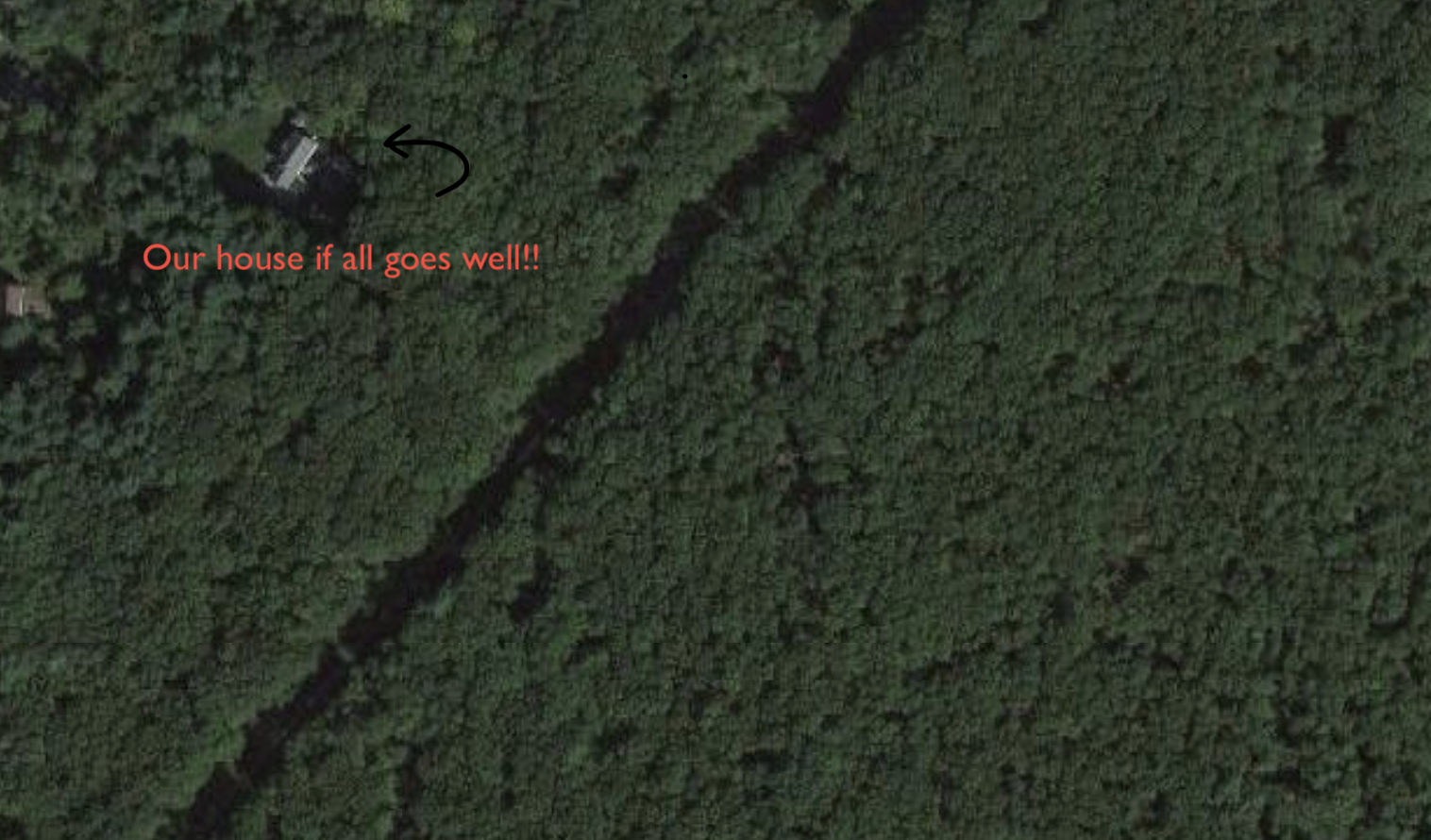
A satellite photo with a house on the left side and nothing but green trees surrounding.

We bought a house! Rather, we have an accepted offer on a house and we are waiting to sign the purchase agreement, but it all seems to be progressing in the right direction.

In some ways, and this feels dramatic to write, it feels like all my life decisions have pointed me in this direction, to this location. As a kiddo interested in Zen Buddhism and feeling like a biracial outsider in my hometown, I longed for big cities and travel. Instead, my first job took me to South Florida, which was just as great as going to a big city—so much diversity, opportunity, art, good friends…always something to do and somewhere to go. I didn’t even know how good I had it until we had to leave. I don’t think I would have ever left if life hadn’t pushed us along. Spence took a buyout from the newspaper where we met and I was unemployed while finishing my MFA. He accepted a job in central Illinois and we moved. I remember traveling with him when he went on his interview. We went to one of the parks in the midwestern city and I cried silently. Back in the midwest. The place I had escaped. I was thankful he had a job again, but not at all pleased to be back in the midwest.

Of course, one of the many many many many things you learn as you get older is that nothing is without nuance. The midwest of my childhood—the place that was at once rural and beautiful but also where I experienced exclusion and racism—is not a monolith. It does not represent all the midwest, and even my hometown and the surrounding area had more opportunity than I recognized when I was young and distracted by my desire to be elsewhere. In this new part of the midwest, I became involved in an art collective, met some of my closest friends and accepted my first full-time job in higher education. The colleagues I worked with there actively helped me develop the skills and talents I would need for every job I accepted thereafter.

Nine years after that first full-time job in higher education, I’m about to move for the third time, I hope to our last home, because I’ve accepted a job that lets me use all my interests (writing, photography, storytelling) in support of a mission I champion completely (educating female, trans, and nonbinary students). I’ve been in the position for a year and have enjoyed it thoroughly, working with great teammates and feeling like I have support and autonomy. If all goes well, we will be closing on the one year anniversary of my starting the job.

And to circle back to why this feels a bit like divine intervention—I’ve never had the opportunity to study Buddhism with great intention. It was always on my own time, reading books, meditating, trying to remember the Four Noble Truths and live the Eight Fold Path. I’ve also become a devoted vegan after spending most of my life as a vegetarian; this includes working on behalf of animal rights in ways that feel best suited to my talents. As I’ve grown, I’ve learned I love silence, being close to nature, bird watching. The girl who thought she needed the big city is actually perfectly fine with visiting big cities and then retreating to her wooded oasis. This new house is surrounded by four acres of woods (that we own!) and is then buffered by a conservation area. If you look at a satellite map (pictured above), you see our driveway and then nothing but green. But it is also 15 minutes from Worcester, where there are so many vegan restaurants, and a vegan animal rights group I connected with through social when I first moved to New England. And there is also a Zen temple! I’ve attended my first meditation/dharma talk and hope to get more and more involved. All while also living an hour from Boston (and Worcester has some great art/food places, too).

Addressing the title of this blog post—I feel almost nauseated with gratitude sometimes. Like, I don’t even know where to begin to pay it all back. The Roshi at the dharma talk this week talked about generational trauma. How the lives of your ancestors and how they respond to trauma affects and shapes you in ways you may not even know. I think of my mom and my paternal grandma, who had difficult childhoods. My dad who experienced so much violence in Vietnam when he was only 18/19. My mom’s grandmother, who was poor and lost so many of her children before they were teenagers, and who’s only recourse of action (or so she felt) was violence against the grandkids she was caring for (my mom and her brother). But I think of my life…of the freedom I’ve had, the encouragement, the support. Of how everything that has led me here is predicated on my decisions, my parents’ decisions, their parents’ decisions and so on. It feels utterly miraculous and my heart aches with gratitude. My immediate family overcame and lived with so much and provided me the ability to follow my heart and encouraged me to do so. Generational gratitude. I wish to spend the rest of my days saying Thank You to them in action and deed.

I am my mother’s savage daughter

Today is my mom’s birthday. On Sunday, I had a two-hour conversation with a witch/astrologer about my birth chart, in which my mom and dad figured prominently. “Do parents typically feature prominently in birth charts?” I asked the witch/astrologer and she said yes, to a degree, but my chart showed them as larger than life. And to me, they were. Two of my favorite people.

If mom were alive today and I called her up to tell her I spoke with a witch/astrologer, I’m certain her first statement would be, “I want to try that.” (Much like it was my response when my dear friend Holly told me she was getting a birth chart reading from a witch/astrologer.) One of my favorite stories about my mom’s difficult childhood in Juarez is when her grandmother and other family members decided to hold a seance…to contact mom’s grandfather, maybe? I don’t remember the details, sadly. They were all seated around a table, my mom under the age of 10, I believe, holding hands with their eyes shut. Once it started, and the person began calling out to the spirits, my mom peeped open one eye to see what was happening. She was promptly kicked out of the seance. (I’m thinking the leader of the seance must have had her eyes open and saw mom sneaking a peek.)

If you know much about astrology, your horoscope, etc., learning about your birth chart isn’t terribly surprising. I’ve read enough about my sun sign and its corresponding qualities and feel that they explain me pretty well. The interesting thing about the birth chart reading is that it takes a sort of holistic look into patterns, the way planets engage with each other, the meanings of various planets, and what they can say about your life experience/decision making processes—a lot of information. Like I said, the conversation was just over two hours long.

I’m not going to hash out everything we talked about, but the most significant insight I left with involved my mom. When my conversation with the witch/astrologer first started, she said, “I’m seeing there may have been some scarcity in your childhood, or a type of trauma.” I was immediately put off because I feel quite fortunate with the childhood I had—protected, fed, loved. When I think of “trauma” or “scarcity,” I think of deep poverty and violent trauma.

And, particularly after my parents divorced, there were moments of financial scarcity—dad and I on food stamps one year because he was laid off; a Christmas where he asked me to choose only one item because he couldn’t afford more—but nothing of deep suffering. No fear of losing our house or the electric going off.

Eventually I opened up a bit more to the witch/astrologer (initially I approached it the way you would a psychic where you want to see what the person knows without saying much, but when I told her this, she said, “I’m not trying to get one over on you—the more information you share, the more we can read your birth chart through the lens of what you’ve experienced and how the two connect.”). I told her the most negative (traumatic?) experience I can recall as a child going into adolescence was absolutely the experience of being a brown girl surrounded by white faces. It distorted my notions of what is beautiful (Eurocentric only); it eroded my confidence; I became a wallflower that wanted no attention because I worried attention would lead to racial slurs.

As we were talking about this childhood experience, I mentioned the fact that I hadn’t learned Spanish as a kiddo because of mom’s difficulty with being understood in the rural midwest. She wanted us to assimilate. She didn’t want us to have any struggles with language. And then the witch/astrologer said: “You can look at that loss of language as a form of scarcity. A loss of connection to other members of your family. A loss of connection to other people who look like you.” Reader, my mind was blown. It was such a new way to think about scarcity, the lack of language—a language that madre should have been proud to share with us, but instead was shamed and mocked for it by people who “couldn’t understand her.” Witch/astrologer said, “you are the daughter of someone who had a politely violent experience in America, who was teaching a little brown girl how to be a brown woman in America.” (Politely violent—what an incredible word combination.)

“The generational influences are yours to grapple with,” she said. “How do you want to live with them?”

Census

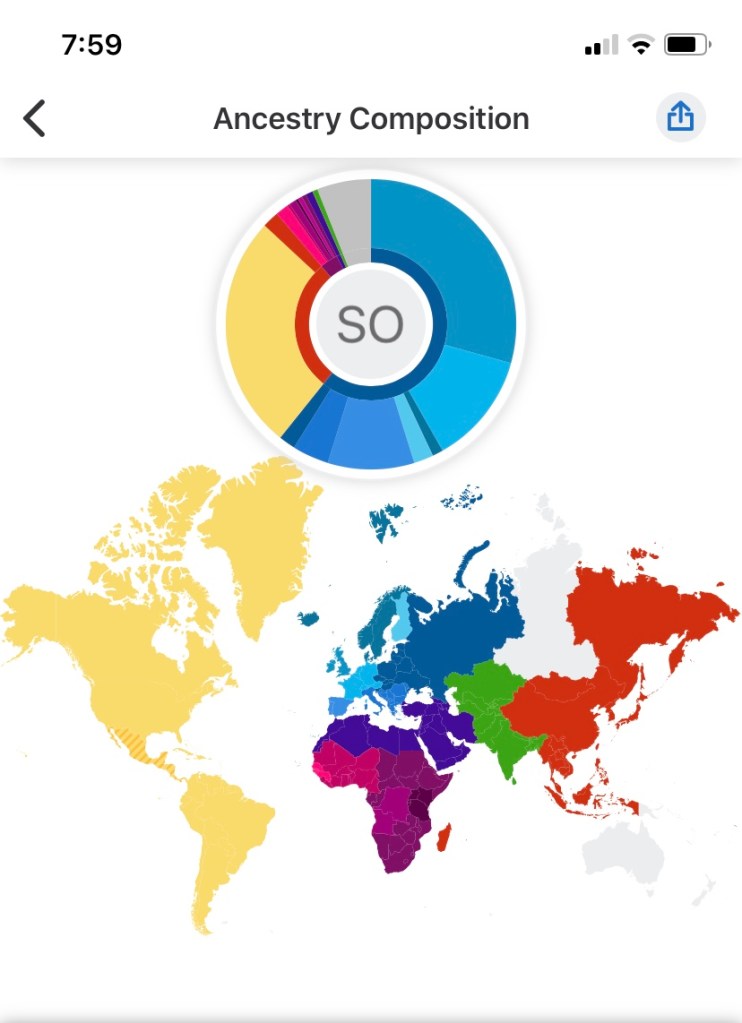
My DNA map looks like a rainbow!

Recently, racial identification has become…challenging. For most of my life I identified as Mexican American. My mom is from Mexico, my dad is from America. Made sense to me. In the last census, 10 years ago, I remember being flummoxed by the fact that Mexican/Hispanic/Latinx was an option for ethnicity but not for race. So I could select Hispanic, but I still needed to choose a race. I don’t remember what I chose then, but this year I chose “other.” My dad is an olive-skinned white man, but I don’t identify as white (alone) because my skin color is not white. My facial features are not white.

Mom used to tell me that Mexico is just like the USA: there are people of all colors/races. Blue-eyed blonds, red heads, etc. Not everyone has brown skin, though “Mexican” has become shorthand for brown-skinned people, particularly in this country. Keeping this in mind, it makes sense that Mexican wouldn’t be a “race.” No more than American would be if you were in another country.

Thanks to a couple of DNA tests, I know my Native American DNA is around 27% and I figured this is where my brown skin comes from. But it never felt right to claim it on forms that ask because I didn’t have any details in terms of tribal connections. I knew I wasn’t likely connected to the Native tribes most Americans are familiar with (Cherokee, Sioux, etc.) and I wasn’t sure if it was only those tribes that the forms were referring to (thinking only of North America rather than the Americas).

I decided to ask my aunt, my mom’s half-sister, if she had any idea about the Native background. She told me that my great-grandmother was part Native American, believed to be Yaqui, an indigenous group living in northern Mexico and Arizona. She said she never talked about it (and I should note, the desire to search for this information is one of privilege. My mom’s family in Juarez had a hard life and whether they were Native or not was not something they cared about. They were Mexican.) She said she remembered my great-grandmother made an adobe oven in the backyard to make bread and gorditas and she wore her hair in long braids. (There is a photo of her in my Instagram with my mom and uncle that show her with the braids.) And she was likely more than half Native because I’m 27% which means my mom was more than 50% which means her mom was nearly full…so that must mean my great -grandmother was nearly full. (Of course, maybe DNA breakdown doesn’t work out so cleanly).

Now I have a bit of detail with the hope to get more. And it has helped with my self-identification. Most of my DNA comes from Europe (mostly British and Irish followed by French and German and then Spanish and Portuguese.) Native American is the next largest part of my DNA. One of the challenges with identifying as Mexican American, Chicana, etc., is that I don’t speak Spanish. I was raised in the middle of Ohio, surrounded by white faces (except my mom’s and brother’s). I (sadly) don’t have much connection with the Mexican culture. I don’t even speak Spanish. (Both things I’m trying to address.) Then the question for me becomes, Is having brown skin and a Mexican mother enough to self-identify as Mexican American/Latina/Chicana? What is the expectation from others in those groups if I claim that background? Would they, at the minimum, expect me to speak Spanish? So the word I’ve selected to describe myself is mestiza. Mestiza (which I learned about in high school) is a person with a mix of Native and European ancestry. That sums me up perfectly. And it feels like there is less of an expectation of language tied to mestiza.

As far as claiming Native American (along with White) on forms…I still haven’t done it. I had another opportunity while filling out forms for my new insurance. It just feels like I’m claiming an experience I haven’t earned because I know there are people from all these tribes that live on reservations or live within tribal communities and that is not me. For now I’ll keep marking “other.”

More than a month

(On Instagram I wouldn’t tell you, but if you keep reading, you’ll know)

Last night I felt suffocated by claustrophobia.

I had a student doing a takeover on the college’s Instagram. Students send the content to me and I post it (we do not give out the login information). He lives in Oregon, so I expected his posts to go late into my night. I actually took the phone with me to bed so I could awaken when he sent a new text. Spence came to bed later and I opted to move to the guest bed so as not to wake Spence with every text the student may send into the night.

I had fallen asleep at 7:30pm; I moved to the guest room at around 9:30pm. Every few hours I would wake up and look at the phone in case I had missed a text. (It turned out the student sent his last text around 8pm my time…maybe he realized the time difference could be problematic. I probably could have asked when he anticipated his last post to be, but I didn’t want it to feel like I was setting a timeframe.) I would wake up and lie in bed and just feel like there was nowhere to go. Like, tomorrow I would wake up and go to my desk in the sunroom and stare at a screen most of the day. I would take walks to get out of the house and get some fresh air, but always back to the house. Typically this brings such comfort to me—I love our house and the space I have. But last night, it felt claustrophobic…like, I can’t leave the house even if I want to because there’s nowhere to go. Most everything is closed. I started to feel that tightness of anxiety filling my chest and then feeling anxious made me more anxious. Thank goddess for Jojo and George because they were both with me and would bring me back to earth when I started getting too wrapped up in how locked down I felt.

Today is the one year anniversary of my mom’s death, and perhaps that knowledge played a role in my claustrophobia last night, though, if it did, it was not conscious. Today, though, I woke and felt anxious…as if I couldn’t possibly sit at a desk and look at my screen for another day. I told Spence about my anxiety from the night before and he told me I should have woken him. I am so sick of this shit, I said. I’ve finally reached my limit. I can be completely locked in for just over a month but then I’m done. And I really want a burrito. I’m actually going to text my boss and ask her if I can take the afternoon off because I cannot bear to sit and look at my computer today. And I’m going to Chipotle, where ever it’s located, and I’m getting a burrito.

My boss okay’d the afternoon off, and my mood was actually lifted during the one Zoom meeting I had. It was to award a journalism fellowship. There were three of us on the deciding team and I had a feeling my top choice may not get it over another choice (all of the candidates were amazing, but I really liked one student (student A), in particular, though I knew the other student (student Z), who was the top choice for the professor in the group (student Z was also on my finalist list) was the most logical choice. The alumnus who was in the group representing the namesake for the fellowship (a deceased journalist who was a friend and classmate of this alumnus) also liked the student I liked (student A), as well as the top choice of the professor (student Z). And so as we were talking, he asked the fellowship coordinator if it might not be possible to award two awards, but not splitting the award—doubling it! So that each student would get $10,000 to start their journalism careers. He seemed to think he could get his classmates to contribute, at the minimum, $5000 and then those funds could be matched with the fellowship funds put aside. I have never been so thrilled to see the wealth of the alumni body put into action as I was this afternoon during that conversation. I said absolutely nothing as the alum was speaking with the fellowship coordinator (I didn’t want to encourage this idea at all since I was contributing nothing to it, but my eyes were wide in disbelief as they were talking it out). Once they decided that was the route they would take, the coordinator said, Okay, so who are the two recipients? And I immediately jumped in and said, for me it’s a no brainer—student A and student Z. The alum seconded that selection, and the professor said he would have gone a different route with the second student (my preferred student, student A), but that he had no problem with going with the selections the alum and I made, which included the professor’s first choice. (I should note this: the professor admitted to not reading two of the clips provided by my preferred student because they were in Spanish. The one he read was from the student newspaper and he thought it was not as strong as the others examples. Had he hit the Translate button at the top of the Spanish-language newspaper website, like I did, he could have gotten a fuller picture of my preferred student’s work, and I think he would have agreed with us. Side eye at the professor.) So I hung up knowing a student (two students!) who has the potential to do really remarkable work will be getting an added financial boost. I could have cried.

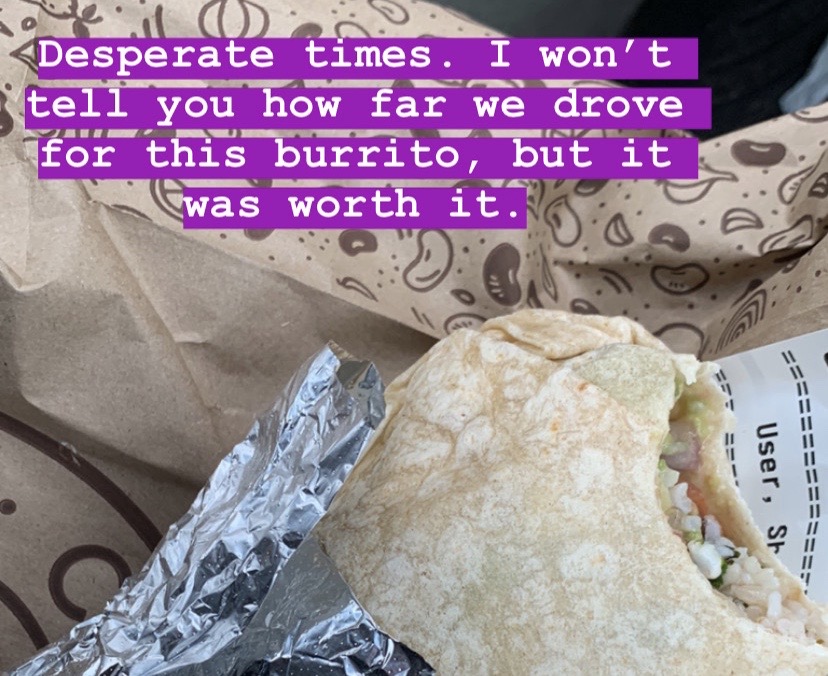
After that, Spence and I drove an HOUR to get a burrito at Chipotle (that’s how far away we are from everything). I was filled with anxiety on the way there—the kind that makes it feel like I can’t breathe. The kind that some people mistake for a heart attack. I tried breathing in and out and that helped. But what really helped, what really made me relax, was biting into that fucking burrito. Just a tiny bit of normalcy—a reminder that I’m not really trapped. That I have such good fortune in this devastating situation. That we can get out and pick up food from a restaurant we like and eat in the car. That we can see people out and about, wearing masks, also picking up Chipotle. After lunch, the weight lifted. Just a moment of normalcy was what I needed—a reminder that we’re all in this together, trying to adapt.

Moments during a pandemic

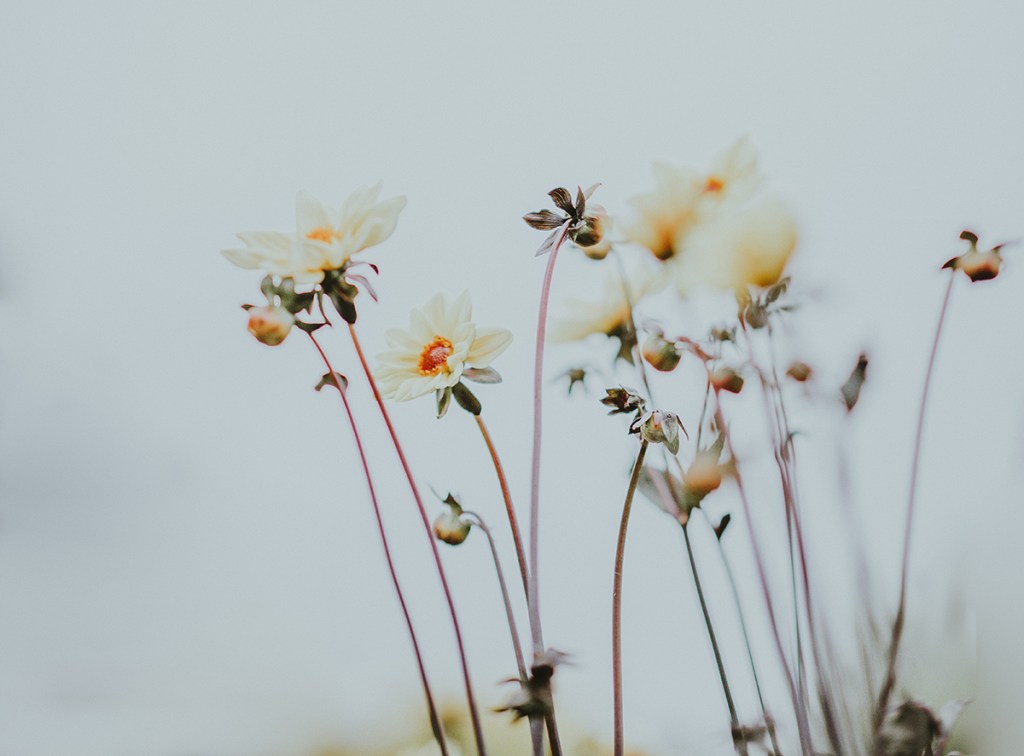
Photo by Annie Spratt on Unsplash

This morning, after showering and rubbing various oils (locally made magical concoctions) on my face and lotion on my limbs, I noted three small red spots under my left eye. They’ve been there for days and I’ve no idea what caused them to appear. But today, they reminded me that when I was a kid and would get feverish, little red dots would appear all over my brown cheeks, like freckles. It was a visual clue to my mom that I was unwell.

From there, memories of mom started percolating—how she would rub Vicks on my chest when I was sick and resting in bed. How she would come to my side when I screamed in pain from earaches or growing pains. Her patience bordered on saintliness. That’s how I remember it. I don’t know what her actual feelings were. And when I put myself in her place, a seven-year-old literally screaming about her earache in the middle of the night, I feel like my patience would shred quickly and it would show.

Today, we’ve been in quarantine for just over a month. Living in Vermont and being able to do my work from home with few problems, I feel endlessly grateful. We have space, places to walk with no concerns about them being crowded, a pantry of food. I do my work in the sunroom and I’m surrounded by light and quiet, except the bird sounds that I love. It is a place of tremendous privilege and I remind myself of that every day. This time last year, I was with mom as she was entering into her last week of life. I imagine how she would respond to being in lockdown from the pandemic. How we would fret over the fear of her being exposed and how much we missed shopping at TJ Maxx and how Trump is an imbecile and how David was making her crazy. It would be terrifying to have her, in her compromised state, also living through this dangerous, easily transmittable virus. Thank goodness for very, very small (minuscule, teeny tiny) mercies.

And remembering her cough that last week of her life—it wracked her, turned her face maroon as she coughed so hard she could hardly catch her breath. The cough, I believe, was from the nodules scattershot on her lungs. It was so bad one night I called the hospice nurse on call. I felt that someone in hospice shouldn’t be suffering in this way—isn’t that what hospice was to help with? Before the call, I had given mom all the medications they had recommended to help with the cough and by the time the nurse came to the house—after midnight—mom was, thankfully, sound asleep. I felt like a dope for calling the nurse after all (who had been 30 or 40 minutes away), but the people who work for hospice are also saints, basically, and she provided guidance about how to help mom when such coughing jags start, and emphasized the importance of calling whenever I feel I need to. When I think of the cough that people have with COVID-19 and the inability to breathe, I think of mom’s coughing experience. It’s terrifying and heartbreaking.

This post has meandered a bit from my original intention. And even my original intention was not totally clear when I started. I read yesterday that everyone should be keeping a journal during this time to capture their experience of the pandemic. I’ve been doing that a bit with the journal I always keep. The recommendation was, if you aren’t accustom to writing a lot, to simply jot down your thoughts and feelings about the day, or maybe note the things you did.

I find myself thinking more and more about mom and all the memories I have of her and also all the memories of her I can’t possibly remember, if that makes sense. I’m reading a book called Separation Anxiety and in it, the mom has a son who is reaching that age when he’d rather be with his friends and finds spending time with his mom tedious and boring. When he was a child, they did everything together. She mourns this change and said she wishes she could tell him that life won’t always be like this—he won’t always have his mom and dad there in this way. It made me think of mom—we used to go shopping every week at a place called Value City. We would get dinner and go shopping. If I was in a mood (which was nearly always when I was a teenager), she would remind me that one of these days, we wouldn’t be able to go out like this together, that these shopping days would be a memory, and she’d say I better enjoy it while I could. I don’t remember if that wisdom had the desired effect at the time. It can be difficult to get through the thick cranium of a moody, hormonal 16-year-old. But now I know she was exactly right. She was right about everything she ever instructed me in. (Happily, I did tell her that at some point in our grown lives.) I just miss her all the time. Not in a weeping, heartbroken sort of way (though that way, too, sometimes), but in a, I-wish-I-could-pick-up-the-phone-and-tell-her-what-she’s-missed sort of way.