I recently wondered if I was depressed. My interest in getting up early to go walking or running has diminished almost completely. Each morning, I am cocooned in my blankets, flanked by my dogs and I am not interested in starting the day. It is such a pleasure to rest there, warm and sleepy.
Just a few weeks ago (August/September), I was getting up early to run/walk and enjoying it. Feeling good. But just like that, the weather cools down and I can barely roll out of bed. And when I do, I feel a bit “blah” about everything. Just unmotivated. Uninspired. Not sad, exactly, but not like myself. (I tend to think of myself as upbeat and positive. My mom used to call my a Big Ball of Sunshine when I arrived for a visit.)
I think about my brother all the time, especially when I’m walking to and from my car at work. I realized one day that I will never get over losing him so abruptly and quickly. And I don’t mean that in some hyperbolic sense, overwrought and emotional. Of course I am filled with grief all the time—for losing all my family and close friends—but it ebbs and flows and strengthens and lessens as the hours go by. That is the nature of grief. But the swiftness of my brother’s experience will always leave me breathless and astonished.
Maybe I’m depressed? I thought. It’s not like me to be this unmotivated to move my body. And when I do, I feel better. When Spence convinces me to hike or go on a walk, I feel better almost immediately. When I’m at work, I feel good, too—interacting with my colleagues cheers me. Perhaps it’s just getting out of my own head that helps.
I receive a substack called Culture Study and it’s excellent. The author recently asked the community to share what they are reading/listening to. I’ve gotten so many great recommendations from this substack. One of the first comments I saw was for a book called Wintering. The commenter wrote “the message is timely as I’m preparing for both literal winter and the metaphorical one I’m dealing with as I navigate a divorce. Ready to hunker down and tend to myself in the next few months, and hopefully emerge in the spring as a brighter, stronger shelf.” Her comment resonated with me. Rather than feeling guilty over not being my usual active self, maybe just see that winter is coming and with it, a time to turn inward and tend to my heart and spirit. To sit with all the changes in my life, in the lives of people I love, in the communities I’m part of. To hold close those I’ve lost and those I’m privileged to still have with me. To just wrap myself in my blankets, get a cup of hot chocolate and a book and be still. (I also bought Wintering)
It’s raining today, which is absolutely fitting for my mood on the unofficial last day of summer. I don’t recall ever feeling summer end with such finality. Even as someone who hated returning to school—I can still feel the dread that crept in my heart as the first day drew closer—it wasn’t so much the end of summer, but the start of school that was the problem.
This summer started off with great joy—a new pool! Something I had wanted for so, so long. I texted photos to my friends. I told my brother I was a capitalist pig, installing my pool and buying first class airline tickets to see him. He assured me I was not and said he was happy I got my pool and could travel comfortably. We have so many texts from before July—jokes, stories, rants, photos, doctor updates. Then July came along—the month of Gary’s birth—and summer changed precipitously. There was hope for a new treatment at the start, and none by the 12th. By the 18th, he transitioned. Remembering it makes me breathless. The speed of it all. It’s so destabilizing.
I returned home just before the start of August. I canceled a pool party I had planned for my friends from work. I used the pool for exercise more than relaxation. I started spending less time in the pool. When the air is cool, the water feels cool, too, and I must have a low tolerance for cold water. There were fewer scorching hot days that made me excited to get in. A week ago, I went to clear the filter basket and inside was a dead mouse. It startled me—having an above ground pool means we don’t deal with animals finding their way in the water. But this mouse did. I had planned to get in the pool after clearing the filter, but I couldn’t make myself get in. As a germaphobe, all I could think of was the mouse soup I’d be swimming in. I cried off and on all day—wept and wept. Spence didn’t understand why I was so bothered by a dead mouse, but it felt more symbolic to me. This notion of joy being polluted, tainted by death. Summer—where the pool was my refuge while I processed my brother’s situation—ending and this poor, dead mouse being a manifestation of it all…fouling the very water I had found sanctuary.
And, of course, Gary is gone. Even typing those words now makes me cry. We had so much hope. And now I know last Christmas was our last one together. New Year’s was our last one together. Our hikes and meals and movies and books and conversations—they were the last.
I thought pretty seriously about shaving my head as a sort of symbolic, cathartic, visual mourning. I watched videos of women doing it; researched how long it would take for hair to grow back (my ultimate plan is to let my hair grow all one length, but with an undercut to grow out, I thought it might also make sense to shave it all and start fresh). I pulled my hair tight away from my face to get an idea of what it might look like. I slept on it and cried and cried. Was relieved when I woke up the next day and hadn’t shaved my head. Went to my stylist who assured me she could help me grow out my undercut without shaving all my hair off. It would take years to grow back to the length it is now. But it’s nice to know that shaving my head is always an option.
Instead I wondered what I could better do to honor Gary’s life? How can I best represent him and our parents in the world? While I was attending an event earlier this week, I briefly thought about sneaking out early, knowing no one would notice, but it occurred to me then that one way to honor Gary’s life would be to fully put myself into the world. He doesn’t get to be in the world anymore, so I need to fully embrace the opportunities around me to put myself out there more often, talk to strangers, go to events, be in the world. Enjoy it. Enjoy people. Don’t sneak out of events.
During one of our visits in Tucson, Gary and I were walking around a park near his apartment, watching people play pickleball. We were trying to understand what the balls were like—tennis balls? Wiffle balls? As we were walking around the courts, one of the players was leaving and Gary stopped and asked him. He gave us one of the balls to hold and when I told him I was interested in learning to play, he told us to keep it and gave us directions for a place that gave lessons. When we left, Gary said it was so cool that the guy was friendly and gave us one of his pickleballs that I could learn the game with. This curiosity and openness—carrying it with me, letting it move me, reminding me to laugh and find joy, be joy—that is a way to honor Gary and our parents.
I know the grief will ease even as it never leaves. It will shape shift and overwhelm me at different and surprising times. But the feeling of this summer, filled with great delight and hope, and then sudden, awful grief, is imprinted on me. For better or worse, I will always be able to recall it.
I published this essay on LinkedIn. Thought I’d share it here, too.
My brother joined the Air Force when I was a sophomore in high school. He had graduated from vocational school with the idea of becoming an electrician, but things weren’t coming together, and our father suggested the military. I was so angry and sad when he left, and a bit irritated at our dad for encouraging him. Four years older than me, he was an incredible source of security.
The military had a profound effect on him. He became disciplined and focused…qualities that weren’t lacking prior to the military, but that came into sharp relief after he joined. And he reenlisted over and over.
In the meantime, I had decided I wanted to go to college. I can’t understate how completely out of left field this came to my parents. My mom had been an excellent student in high school, but went into the workforce right after. My dad had quit school in the 8th grade to go to work, and was ultimately drafted and went to Vietnam. He would earn his GED when he was 36. There was no talk about higher education in my home. The goal was graduating high school and then finding work to support yourself. However, there was a lot of reading in my home, and we all stayed informed on current events. I adored reading and fancied myself a writer. It was when I read a novel where the protagonist attended Columbia and became part of the writers’ scene there that I decided, I, too, would like to go to college and be surrounded by artists and writers.
When I told my parents, they supported me and helped me find my way, especially my mom. We were all clueless. There was so, so much we didn’t know, but they did what they could. My dad told me years later that when I came and told him I wanted to go to college, he thought to himself, yeah, I don’t see that happening. In his mind, college was for straight A students with money, and I had neither of these things. But he kept it to himself and I went about my way, blissfully ignorant but willing to figure out how to make this plan work.
I graduated from Ohio University and got my first full time job in West Palm Beach. My parents were thrilled. College to them was not learning for its own sake, but for getting a better paying job than you could with a high school diploma. Happily, I enjoyed both approaches to college, and was pleased to be paid for my knowledge after I graduated. My brother had started taking classes while in the military. He decided he’d also like to earn his bachelor’s and would ask me questions about the process, or have me read his writing assignments. The military took priority, however, and he would often put classes on the back-burner while traveling the world— something I envied a bit, even if I wasn’t cut out to be in the military.
After a few years in my first full time job, I decided to return to graduate school. My mom, the most practical, play-it-safe person in my life, thought I had lost my mind. Why would I give up a good paying job to go back to school? (And there were times after I graduated, which happened during the recession, when I asked myself that question.) But she had been diagnosed with ovarian cancer, which reminded me life was short and there was no time like the present to make leaps of faith, so I did. My brother, still working on his degree when possible, started referring to me as the smartest person in the family, which made me laugh.
Eventually I started a job in higher education that allowed me to build my skill set and move into other positions that aligned well with what I wanted to do with my time—talk to people and tell their stories. My brother retired from the military in 2015, after nearly 24 years, and finally dedicated his focus to finishing his degree. He was great at economics and all things computer related. His plan was to go into IT security. He finished his degree just after turning 50. I wanted to surprise him for his 50th by arriving on his doorstep unannounced, but he was not big into celebrating birthdays, and I knew he was stressed about the work he had to do to finish the semester. When I told him what my plan had been, he thanked me for knowing him well enough to not follow through.
Then, in November 2021, just four months after turning 50, he learned he had metastatic pancreatic cancer. In one of our video conversations after learning this news, he said, “Look what came in the mail today,” and held up his diploma. He graduated magna cum laude. “I’m actually glad all this happened after finishing my degree,” he said, referring to his diagnosis. “I’d be pissed if it happened before.”
That outlook is something I think about when I remember that conversation. Gary died July 18, 2022, just a few weeks before his 51st birthday. When I learned about his diagnosis last year, I was so angry because he had just finished his degree and was getting ready to start the next chapter of his life with a job he wanted. But when he said he was happy to have finished his degree before all the health challenges started, he reminded me that education is its own reward, regardless of what you do or don’t get to do with it. He spent the last years of his life immersed in formal learning and he loved it.
On Monday night, my beloved brother transitioned out of this earthly realm. For many of his friends, this will come as a terrible shock of news and I’m sorry for that. He was diagnosed with metastatic pancreatic cancer just before 2021 Thanksgiving and had been taking treatment for it since. He kept this news close to the vest and told me the Sunday after Thanksgiving so as not to “ruin the holiday” and only because he knew how shocking it would be if something happened to him due to the diagnosis and I learned by getting a call from the hospital. We spent the holidays together, and, with his permission, I let just a few more family members know what was going on. When I visited again in Feb/March, he still hadn’t told anyone new, not even his closest friend Roy, who lived just a few hours north in Phoenix. “I know I need to tell him,” he would say, pensive look on his face. Thankfully, Roy called one day during my visit and Gary broke the news. His support system grew and that’s what he needed/what I wanted for him.
The first round of treatment he took was chemo one week, one week off. After he adjusted to the treatment, he tolerated it better than many. When I visited in December, I was adjusting to seeing him in such a different form—he lost a lot of weight—and he was adjusting to the treatment. I made our Christmas dinner (if you could call it that—I am no cook) with the primary dish being mashed potatoes and corn—his favorite combination from childhood and one I thought could go down easily in a nauseated stomach. Of course, my appetite was normal and often ravenous, so I would say, Hey! Time to eat. What do you feel like? And he would leave it to me, but he would always choose something and would be surprised when his stomach tolerated it. One night I decided on Indian food and he was unsure he could keep it down, but was really craving tandoori chicken. I brought it home and he inhaled it, calling it some of the best he’d had and thanking me for even suggesting it because it wouldn’t have occurred to him if he’d been alone.
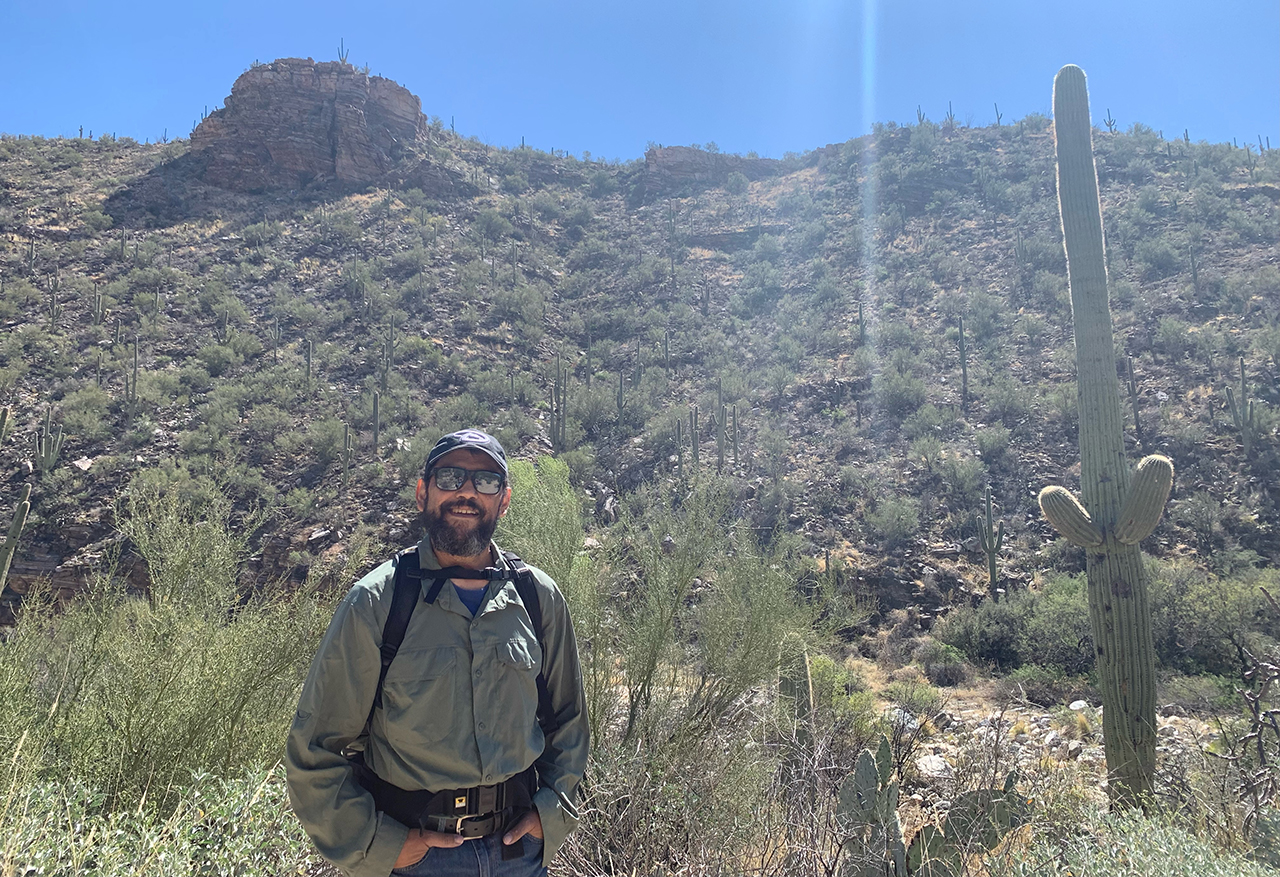
I am so grateful he was able to keep moving for most of his time on treatment, too, On New Year’s Day we took a four mile walk around Sabino Canyon Recreation Area. When I returned in March, he was actually a bit better acclimated to his treatment and we took a six mile walk through a place called Seven Falls, taking breaks as needed. We didn’t make it to the end, which he had hoped, but we came damn close. He said he had hoped to make it to the falls so I could take his picture and he could post it and say Fuck Cancer. I told him, “Gary you can do that with any picture we’ve taken on this trail. We’ve been walking for miles and you are going through chemo. I know healthy people who would struggle on this hike.” Together we visited the botanical gardens, the museum of the desert, Pima Air & Space museum, and Colossal Cave. We were both a little nervous with Colossal Cave because we learned we’d be descending six stories below ground and we both knew that meant walking back up. But it was a slow pace and Gary had time to recover during each stop. Gary took me on a tour of the Air Force base and showed me where he worked and explained various elements of the base to me.
When we learned in June that the chemo wasn’t working and a second lesion had grown on his liver and the first had gotten bigger, the doctors switched his treatment to one that targeted the BRCA mutation—a mutation he learned he had after the diagnosis and what likely played the biggest role in him having pancreatic cancer. On June 28, he had a big dinner, eating outside to watch the sunset in a place he and I regularly picnicked whenever we picked up food. He’d gotten into the routine of eating well during his recovery week, particularly the day before, because he knew his appetite would drop off significantly during treatment week. He started his treatment on June 30 and, honestly, never really recovered. His fatigue was debilitating. But he would also tell me, “I’m working through it.” He started responding to my texts more infrequently during this time. Texting was hard due to neuropathy. Finally, in the week when he was to start his next chemo session, he called and said he was going to the ER at the VA. His neighbor, who was also a friend, had been helping him and was alarmed at how weak he was. In the ER he learned that the liver lesions had grown even larger and the chemo likely triggered an infection that was just throwing the body into chaos. He soon learned there wasn’t much more they could do for treatment with a liver so deeply compromised (his body was already showing the impacts of a failing liver at this point).
I arrived early Friday morning and after processing the news together and the corresponding emotions as best we could, we quickly went into our comfortable routine of chatting, reminiscing, laughing laughing laughing. Once he agreed to enter hospice, the nurses unplugged everything and eventually we moved out of the ICU and into a private room elsewhere on the floor. Since it was Friday, everything regarding paperwork would wait until Monday. On Friday and Saturday, he would be as much himself as he could be considering the situation. His friend Roy and Roy’s wife Cam came down at noon on Saturday, bringing him chicken wings from a restaurant Gary loved. They stayed all day, and were still there when I left to go home. On Sunday his neighbor visited, and he had good conversations with his aunt and uncle. I have a great little video snippet of him and his uncle on the phone, telling a story of a mutual friend and laughing laughing laughing. When I arrived Monday, I could sense right away, mostly in the cadence of his speech, that things were already a bit different and that Sunday was likely the last day of near normalcy. Sure enough, as the day progressed, I could see the stages of the transition starting—the most familiar one being his talking to people I couldn’t see or saying something to me out of the blue as if we’d been talking about something unrelated to anything we were experiencing. And this is something I want to share with his friends: that entire part of the process, when the mind was responding to the changes in his body—every word out of his mouth was funny, kind, affirmative. He would repeat over and over, “He’s a good dude.” (If you know Gary, you can probably hear him saying this—it was a common refrain when describing people). At another point he said, “Yeah, it looks like everything is going good for those guys.” Another point he whispered, “Vegas, Vegas, Vegas” (he loved Vegas). “Freaking awesome” and “good freaking deal” also peppered these conversations. When his eyes would come into focus and he’d look at me, I’d say “How you feel?” And he’d always, ALWAYs say, “I’m doing good.” “Are you in any pain,” I’d ask. “No, I’m doing good.” He did get restless in bed, moving around as if he couldn’t get comfortable but every time I’d ask if he needed help, he’d say he was fine and relax for a moment. His agitation never seemed painful or anxious.
By the end of the afternoon his restlessness was increasing and when I asked if he had pain, he said a little. It was then that the nurse gave him a pain med to help with pain and restlessness and once the pain meds hit, he continued the transition with his eyes closed and the process ended at 9:30pm. I held his hand, talked to him, rubbed his legs. I let him know how much he was loved, how grateful we were to have him, and how he would be missed. He and I were with both our parents when they transitioned, and know it can be challenging. I spent much of the weekend just pleading with the universe to let his process be easy—I had read that end stage pancreatic cancer can be quite brutal and I was scared about that. I asked mom, dad, grandma, god, the universal energy to just please let his experience be as peaceful as possible, and I have to say it was. I am so grateful for that.
Gary was retired Air Force. He had turned 50 last year (his birthday is later this month), and had just completed his bachelor’s degree—a lifelong goal—when he received the devastating diagnosis a few months later. We talked about fairness and I shared a quote from Christopher Hitchens regarding Hitchens’ own cancer diagnosis: “To the dumb question, why me? The cosmos barely bothers to return the reply: ‘Why not.’ ” We agreed that this situation fucking sucked beyond measure. Just infuriating. Enraging. But we also acknowledged that this is the way of the human experience. We all face a moment like this. Gary traveled all over the world. He hiked mountains in Korea, rode bikes in Italy, has been to more places than most thanks to his military career. He said he had a great life, and we had had great childhoods supported with family that we loved deeply. There was nothing more he could ask for. Except for more time, of course. There’s never enough time with the people you love on this exquisite planet we inhabit. With his death, my nuclear family—the people who loved me first and longest and without reservation—are all gone. The grief is difficult to put into words
There won’t be a service. He will be interred in a veteran’s cemetery—I’m working on those details. For those he didn’t tell about his prognosis, it was largely because he didn’t want people to feel sorry for him. He wanted people to remember him how we was—your favorite memory of him is what he wanted you to think of when you heard his name. Take a hike in his honor. He loved hiking. And laugh laugh laugh.
When my mom was dealing with her cancer treatments over the years, she would always tell me that my brother and I should be closer and keep in better touch. “You’ll only have each other when I’m gone,” she’d say, and I assured her I knew and that we do keep in touch (though it was primarily via text and scattershot). If only she knew that two years after her death, my brother would receive his own cancer diagnosis—the kind of cancer diagnosis that is worst case scenario, nightmare diagnosis. He went in to the hospital thinking it was this treatable issue and then was delivered the worst case scenario news.
I’m thinking about this this morning because my brother started his new chemo treatment yesterday. I worry about him living alone while going through a new treatment. His neighbor is a friend (who has also had cancer) and she is there for him, as is his best friend who lives a few hours away. But I just worry about not doing enough, not being there when I should be. But also I don’t want to loom over him like a needy caretaker, asking him every hour how he feels. We’ve been very fortunate that he has handled treatment as well as can be expected—he’s otherwise healthy and when he’s not on treatment, he feels like himself. It also bothers me that he’s living in the hellfire of Arizona in the summer, so there’s not a lot to do to get him out of his apartment because it’s three digit temperatures all the time.
I’ll be joining him in the hellfire of Arizona later this month. It’s July 1. 51 years ago this day, mom was 30 days away from giving birth to my brother. He was her first child and I remember she said she was so afraid of going to the hospital too early or with false contractions that she waited so long, he basically popped out the moment she got to the hospital. (She was always afraid of making a scene or causing any a ruckus.) I’ll be there for his 51st birthday to celebrate with him and get a sense of how he is doing. When I video chatted with him a few weeks ago, he looked great. I was so scared I was going to see signs of liver issues. That’s the issue now—his other chemo stopped working and during that time it stopped, a second lesion has grown on his liver. When he got his bloodwork done for his chemo, his liver enzymes were off, which is not surprising because of what’s happening to it. My deepest hope is that the treatment, which is supposed to target BRCA gene-specific causes of cancer, has an immediate effect on the liver lesions.
Frankly, I’m scared. I’m scared of how this is going to progress. I’m scared because I have been through this process two other times with my mom and dad, so while I’m hopeful and optimistic, it’s tempered with fear. I think a lot about fairness and unfair it is that my brother is dealing with this, but that’s always rebutted by Christopher Hitchens: ”To the dumb question, why me? The cosmos barely bothers to return the reply: ‘Why not.‘” It can feel unfair—perhaps it is unfair—but there isn’t any sort of larger game at hand. We are animals; we have bodies that will eventually fail us all in myriad ways. This is the way of living. I also take comfort in the words of the Dalai Lama XIV: “There are only two days in the year that nothing can be done. One is called Yesterday and the other is called Tomorrow. Today is the right day to Love, Believe, Do and mostly Live.”
So, we text, I hope that he handles the treatment well, I know I’ll be there at the end of the month. I know I can be there sooner as needed. I know that he can come stay with me whenever he wishes. We live.
(Side note: I had to step away to cry as I was writing this post. While I was standing in the kitchen and holding a tissue to my face, I heard a WhatsApp alert. I walked to my laptop and saw that the woman I’m tutoring in English had just sent me a TikTok video of scenes of beautiful flowers with animated butterflies flittering about and polka type music in the background. She has never sent me a TikTok before and this particular one brought a smile to my face. And I needed it. The universe knows.)

 The Puzzle Box