Wherein I love running

Though that’s not exactly accurate.

I love finishing a run. And often, for the first two miles or so, I love the act of running. I love the goal of distances and times, even when my times never seem to improve and the distances aren’t getting any easier.

I don’t want it to be easy. I just want to be better at it. I know the people I watch who run and make it look effortless are putting in more effort than I can imagine. Effort outside the act of running–they’re strength training, and cross training, and eating properly. 

That goes for all athletes, particularly the ones who excel at what the do. Whether they excel on the local stage, the national stage, or the world stage (all of which have different requirements for excellence). 

During the Final Four, NPR did a story on Lebron James and how he was playing in every game because many of his teammates were out on injuries. The reporters made the point that this was a difficult task to take on, playing in every single game for large segments of time. They talked about him barely able to keep his eyes open at times. His recovering days included time on a stationary bike (first thing in the morning) and dips in an ice bath. I imagine his muscles achey and sore. I think about the idea of recovery days still requiring a great deal of physical work.

I love running, and yet I can only get myself out of bed early on race days. Some people jump out of bed and hit the road at 5am in order to get the run in before work, but I’m too busy hitting snooze over and over.

I love running, but it’s not something I turn to as a way to unwind. It is an obligation; a promise to myself to keep moving, even if I’m tired after work. A promise to push myself more because life is short and I want to keep my body in motion.

I love running even though I see little to no change in the scale numbers. I’ve stopped looking at the scale these days. My only measurements are how far I can go and for how long.

I love running even though I will likely never win a race. The people who win races (even local races) are at a caliber beyond my reach, and I’m not meaning that to be a put down about myself. It’s as if there are people whose bodies are designed for running; people who have been running out of pleasure and fun since they were children. And so my goals are adjusted to beat my last time, or to run farther than I did last time. Those are the races I’m in, and they’re good enough for the time being.

Running is always a decision for me. It is not my default mode; it’s a mode I want to be in. Runner is a descriptor I want to claim for myself.

And though it’s mostly difficult, I love running.

(Next challenge: 15K in September)
Wherein I complete my first 10k race

It’s been a summer of training for my first 10K. Weekly group runs followed by solo runs on the days in between. And now summer is officially over because I just completed the race this morning. A summer of running to get to this morning.

The entire distance (6.2 miles) was more challenging than I thought it’d be considering I’ve run a few 5ks in my time. Six miles is still a difficult distance for me to hit on a regular basis. Four to five is my sweet spot. 

I also started interval running (see last post), and that method helped a lot. I think it will be necessary as I train for longer races.

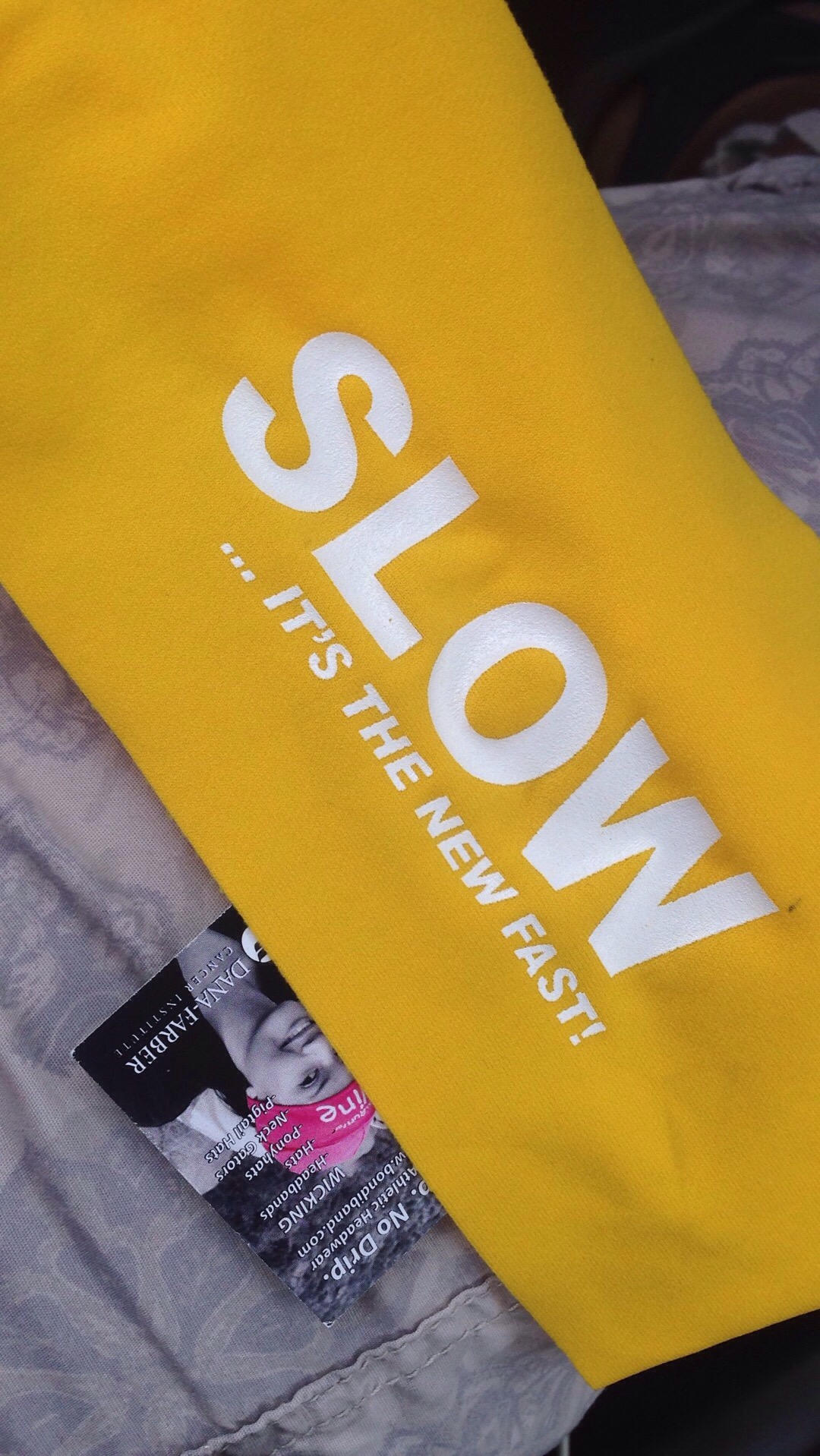
But Race Day! I bought a head band that I though perfectly summed up my feelings about the whole thing:  

 And my right hamstring felt really tight yesterday–like, tight enough that I was altering my walk. So I bought a massage stick at a local sports store and used it the last night, and increased my stretching before bed. When I woke up, I felt GREAT (considering it was 6am).

The race took place at the fairgrounds and my husband dropped me off so I didn’t have to worry about parking.

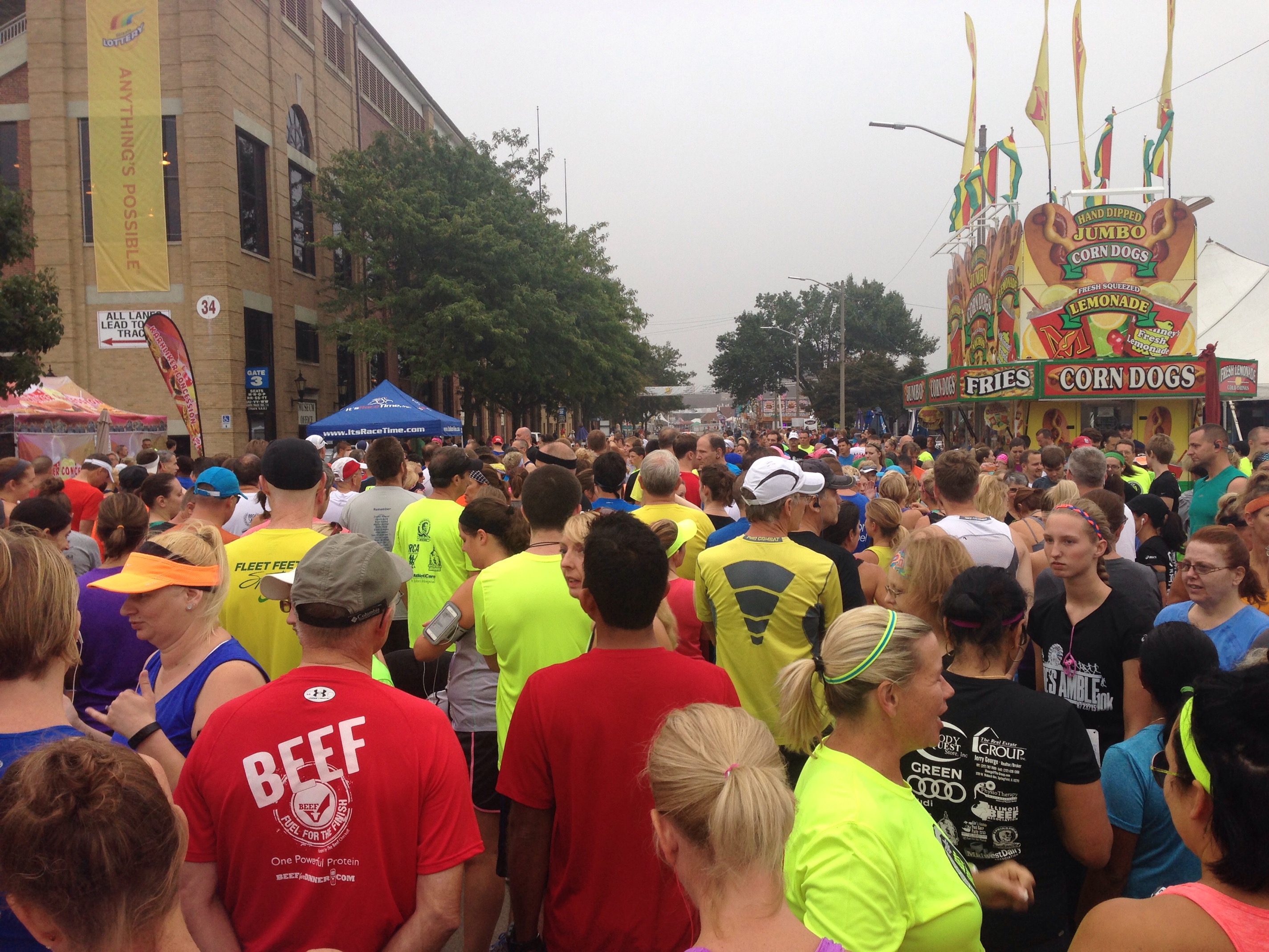
Lots of people!  

 I submerged myself in the middle of the pack. I’m a realist like that.

Then we were off! I decided not to start my interval running until I was out of the fairgrounds and we could spread out a bit.

There were so many people ahead of me. In 5ks, I’m pretty good about staying in the middle of the pack, but it seems the farther the distance, the farther behind I fall in the pack. I tried to not dwell on that.

Finally, I turned my interval app on. And I’m running and running and running and running, and I think to myself, “surely four minutes has lapsed by now.” I pull out my iphone and see they have lapsed and I’m half a minute into my minute of rest! It seems sometime during my setup efforts, I turned the buzzer off the app and now it was running through the intervals without alerting me. So, I had to run with the damn phone in my hand, which I hate. (I like my hands free when I’m running.)

Then, I’m about fifteen or twenty minutes into the run and I see a police car coming toward us in the other lane. The roads are closed to traffic so I was a bit confused until I heard some cheering. The eventual winner of the race was already on his way back (with a police car leading the way). And the guy was killing it–practically sprinting his way to the finish line. It took him just over 30 minutes to run 6.2 miles–something like a 5 minutes 13 second pace. It was incredible to see–as were all the runners right behind him, though he was the clear leader. The winner is actually well known in this area. He’s the president of our running club and an all around running enthusiast and race winner.

Most of the rest of the race went as planned without a lot of difficulty. I stopped to save an earthworm that was crawling in the dirt on the road. I talked to my legs as necessary, letting them know this was the last time they’d have to run up this hill or that hill. (This course has a lot of intense hills.) At one point I thought to myself, “hmmm…I’m not so sure distance running is for me.” I finished strong (once I see the finish line, I can push myself to speed up a bit), and I completed the race in an hour and eight minutes. I was hoping to get closer to an hour, but now I have a goal to work toward.

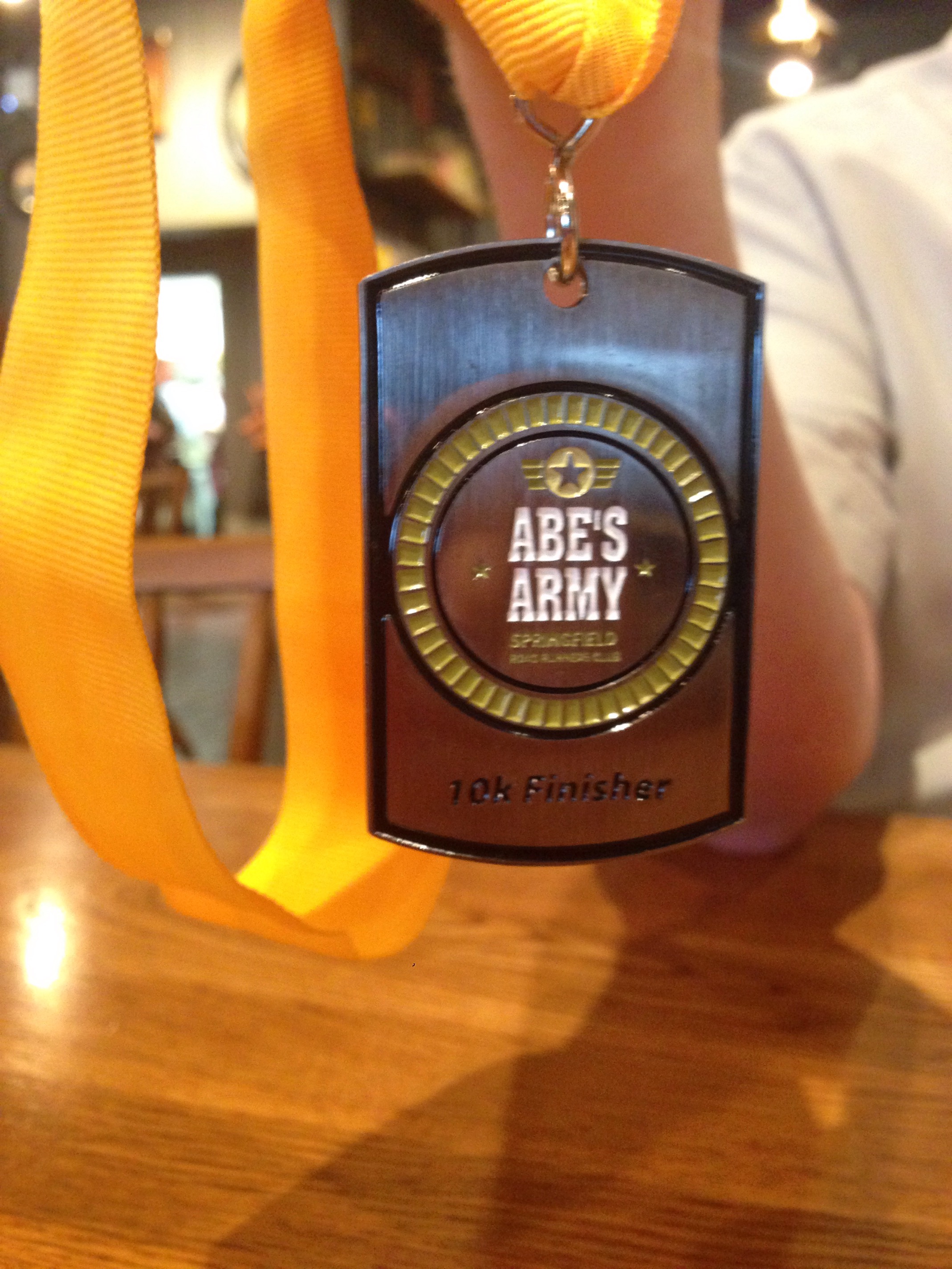
Yes I did wear my medal all day.  
Then there was french toast and coffee, a shower, and a five hour nap where I slept like the dead.

And already the next race is close–a 15 K the third week of September!


Identity politics

Catching up on Hitchens’ publications, I came across an article by him in the Washington Times called The Perils of Identity Politics. It was published in January, so I’m rather behind in responding to it (a trend in my life these days). In the article he writes,

Here again, the problem is that Sen. Obama wants us to transcend something at the same time he implicitly asks us to give that same something as a reason to vote for him. I must say that the lyricism with which he does this has double and triple the charm of Mrs. Clinton’s heavily-scripted trudge through the landscape, but the irony is still the same.

What are we trying to “get over” here? We are trying to get over the hideous legacy of slavery and segregation. But Mr. Obama is not a part of this legacy. His father was a citizen of Kenya, an independent African country, and his mother was a “white” American. He is as distant from the real “plantation” as I am. How — unless one thinks obsessively about color while affecting not to do so — does this make him “black”?

Well, his history does not make him “black,” but the people’s perception of his skin color does. I mean, this seems pretty obvious. It’d be great if people stopped making assumptions about people based on such things, and much of Hitchens’ article argues the reason why race and skin color shouldn’t matter, but that doesn’t change the fact that it does matter for many people. People may not go out in the world with the intention of making assumptions about others based on skin color, but it happens (dare I say it happens all the time?). [My mother is convinced that people see her and hear her speak and assume she is an illegal alien. I doubt this very much, but who knows?]

Of course, all this leads Hitchens to say he will not be voting for Obama or Clinton, and that his not voting for them has nothing to do with race or gender. I believe him when he says this, but it hurts to know he’ll be voting for the Republican nominee (though I’m far from surprised)

O, Hitch! Why? Why must ye torment me in this way?

thinkin’ about kulchur

According to my Oxford dictionary, the second definition for “culture” is “the customs, ideas, and social behavior of a particular people or group.” I’ve been thinking about this because it feels like I’m experiencing some cultural friction at the day labor center. In my experience, this friction nearly always stems from the issue of language, and, to a lesser degree, gender. Brian, over at Incertus, recently published an Ask a Mexican question and answer youtube video. In the answer, Arellano made a reference to “symbolic ethnicity,” which is a phrase that works well with my experience. When I was a part-time photojournalist at the Dayton newspaper, my boss was trying to help me get a full-time job at the Florida sister paper. One of my “selling points” was my being a minority. I remember conferencing with him in his office, and discussing whether or not I was bothered by the fact that race could play a role in my getting the job. I told him I’d prefer to have the decision based less on that and more on the work I submitted. He said he believed it was important for a newsroom to include voices and faces that accurately reflect the community it’s covering, and I shouldn’t be bothered if my race is a factor in the hiring process. A diverse community demands a diverse newsroom, he said. I remember thinking (though I don’t think I said it to him) that hiring me was like hiring any white Ohioan because I was raised in a Midwestern culture, surrounded by my paternal (Caucasian) family and had little to no connection with the Hispanic culture at all. I may have had run-ins with racists on occasion, but my mentality was white, working class Midwesterner. Anyone looking to hire someone as representative of the Hispanic community was doing a disservice by hiring me; however, if they only wanted a face that fit the profile, then, yeah, my face fit.

I’ve only recently realized how much I’ve been missing by not paying attention to the maternal side of my ancestry and am trying to make up for lost time. As a kid, my world was Ohio, largely due to financial constraints that kept us from visiting Texas and Mexico with any regularity. Now, as I fumble with Spanish, or interact with workers by speaking English, I occasionally run into a bit of friction with some of the guys. Typically, the workers are amused with or surprised at my inability to speak Spanish, or interested in practicing English. But sometimes there is friction and attitude. When I’ve asked mom about this (my own, personal Ask a Mexican cultural reference), she speculated that some of them may view it as me denying my heritage—by not speaking the language, I’m trying to remove myself from the culture. This all relies on visual identifiers and assumptions, of course, which is problematic. It assumes that if one has a particular look, then one must have a particular experience (she looks Mexican, therefore she must speak Spanish). It doesn’t take into consideration the possible cultural combinations people embody.

When asked, I describe myself as Ohioan—in spite of my Hispanic look, in spite of my Irish name. Perhaps I don’t place enough importance on culture because my family did not focus on it when I was growing up. We had each other, we had our holiday traditions, we had our occasional trips to visit mom’s family, but, for better or worse, we grew up in a vacuum that didn’t dwell on culture or ancestry. So, as an adult, I’m miffed when people get miffed with me for not speaking Spanish (why would I? I grew up in Ohio), and I get miffed when people make assumptions about me based on my appearance (Once, after leaving the Breakers hotel in Palm Beach, I realized I forgot a camera lens and returned to pick it up. As I was walking toward the hotel entrance, some guy came up to me—totally out of the blue—and asked, “Are you here to pick up your check?” Ummm…no, asshole. I don’t work here. Another time, in the courthouse (again, taking pictures), a woman turned me into security because she refused to believe me when I told her my (Irish) name).

In 2008, with all the hoopla over immigration, visual identifiers are as significant as ever. When I’m in the day labor center, I blend in with everyone else there. It was this observation that made me realize the disservice I’ve been doing to myself by not paying attention to this side of my heritage—the one most people would use to categorize me. The qualities that distinguish me from the workers are qualities not discernible by the eye. I may identify myself in a particular way (Ohioan, Midwesterner, etc.), but does that make any difference when so much of experience is based on the visual identifiers others use to identify you?