Today at the vet clinic I took a call from a woman who felt it was time to put her 15-year-old dog down. She said he was whimpering, and not doing very well. I found an emergency slot for her at the end of the day, and told her to come in at that time. She was understandably broken up over the phone, and I felt low after finishing our call. That would be our fourth euthanasia today, a lot for a Saturday, and many tears were shed by people of both genders, young and old.
She was an older woman, perhaps 70 or so, and she came at the designated time and carried the dog inside, wrapped in a towel. His face looked old, he was thin and losing hair. He looked every one of his 15 years, which translates to about 90 in human years. She was escorted to a room, and stayed with him until he was gone. Her face was wet, and her eyes were red as she emerged from the room, spoke a soft goodbye and left our office. I waited for her to drive from the parking lot and locked the doors so we could start closing down for the day. One of the technicians came to the front and asked, “Did you see that dog?” “Yeah, he looked pretty old,” I said. He waved me into the examination room where the other technician was finishing up with dog. When I entered I saw the old dog had an enormous tumor on the side of his belly, about the size of a tangerine, protruding and red. He was nearly hairless, he had several smaller tumors on other parts of his body, and he looked positively emaciated. I was shocked by his physical condition; it was much more severe than I initially thought; he looked like the Crypt Keeper from Tales of the Crypt. It was abundantly clear that the woman loved this dog, but it was also clear that the dog should have been released from his suffering some time ago.
This experience made me think about attachment, and how hard it is for us to let go of those people or animals we love. According to buddhist thought, attachment is the root of suffering, and one step toward finding liberation is knowing that you cannot hold onto anything forever. That this moment, whether happy or sad, will change. Your health will change, your life will change, your physical characteristics will change. Wishing it were otherwise, or wishing things wouldn’t change only adds to our “suffering,” because that is wishing for the impossible.
But wishing for the impossible is what we do sometimes. I was not raised in any particular religious faith, but somehow, even as a child, I knew about Jesus and God. Perhaps my mom spoke to me of them–she was Catholic and though she decided to rear us without Catholic doctrine, there was still a picture of Jesus on our pantry. I distinctly remember I prayed all the time when I was a middle schooler. I prayed that my mom, dad, and grandmother would live forever, or at least until they were 100. I prayed for selfish things too, though, conveniently, I don’t recall those prayers as clearly as praying for the immortality of my family.
And even when I said those prayers as a child, I knew no one could live forever; I just wanted the family to keep going for as long as possible. That’s what I meant. And the family held up well for a long time. I got to spend 30 years with dad and grandmother, the third anniversaries of their deaths taking place this month and next. I think I finally stopped praying to God when my father died. It seemed like such a futile act after that. I read a quote recently, and I can’t remember who was being quoted, but he had said something along the lines of, those who pray to God are usually praying that two plus two not equal four. I thought this was totally accurate. When I said all those prayers as a child, and even when I prayed for dad’s health to be restored, I was praying that two plus two not equal four.
I don’t mean to diminish the power of prayer here. I believe that positive thoughts and energy absolutely influence the world around us. I’m speaking more about the interventionist prayer, when we use it to ask that things be different than how they are. Buddhism teaches that one needs to learn to accept things as they are, because wishing for it to be otherwise only diminishes the moment you’re in. This is what I try to embrace, though I think if a health crisis were to strike my family or friends again, I’d find myself asking that two plus two not equal four.
It’s human nature, I suppose. None of us want to lose those people or animals closest to us. The idea of it makes my physically ill sometimes, but then I remember to bring myself back to the moment and be thankful for them now. Because worrying about or dwelling on the mortality of us all isn’t going to change anything.
I spent some time on Friday reading from the works of the late Michael Browning. He was one of my favorite writers from the Palm Beach Post, and he had an exquisite way with words. After his brother died unexpectedly, he wrote a story about taking in his elderly mother. This was a paragraph I meditated on for some time:
For all our later disagreements, I still pitied him, and drove home with tears in my eyes. It was difficult to go through the old family pictures and see him again as a bright, sparky little kid, wearing a cowboy hat or a football helmet or a Cub Scout uniform, grinning brightly next to a Christmas tree, or with an Easter egg basket in his hands. We all start out life so gaily, so bravely!
We do start out life so gaily, so bravely. And it’s difficult to see time measured out in black and white pictures, or by ashes in an urn. One of the last requests I remember my dad making before he died was to look through a stack of old pictures that were kept at my grandmother’s house. I found them and returned to his house with the box in my hands. He shuffled through the small prints, looking at black and white pictures of himself as a small boy, with his brother and sister, his dog, his wagon. He didn’t appear sad while looking at them. He made his way through the stack and set them aside to continue watching television. I wondered what he thought of this inventory he just took of his life as a youngster, but didn’t dare ask. He kept his thoughts to himself.
But I know when I look at those pictures now, and when I look at pictures of my own childhood, with all of the family looking happy, brave, and indestructible, it’s hard to let go.



 It was a wet walk home last night, but this greeted me from the kitchen window after I had dried off. And today I was sitting at the desk in my office, and noticed our grass is a beautiful green. It had been brown for so long, I’d forgotten how alive the green looks!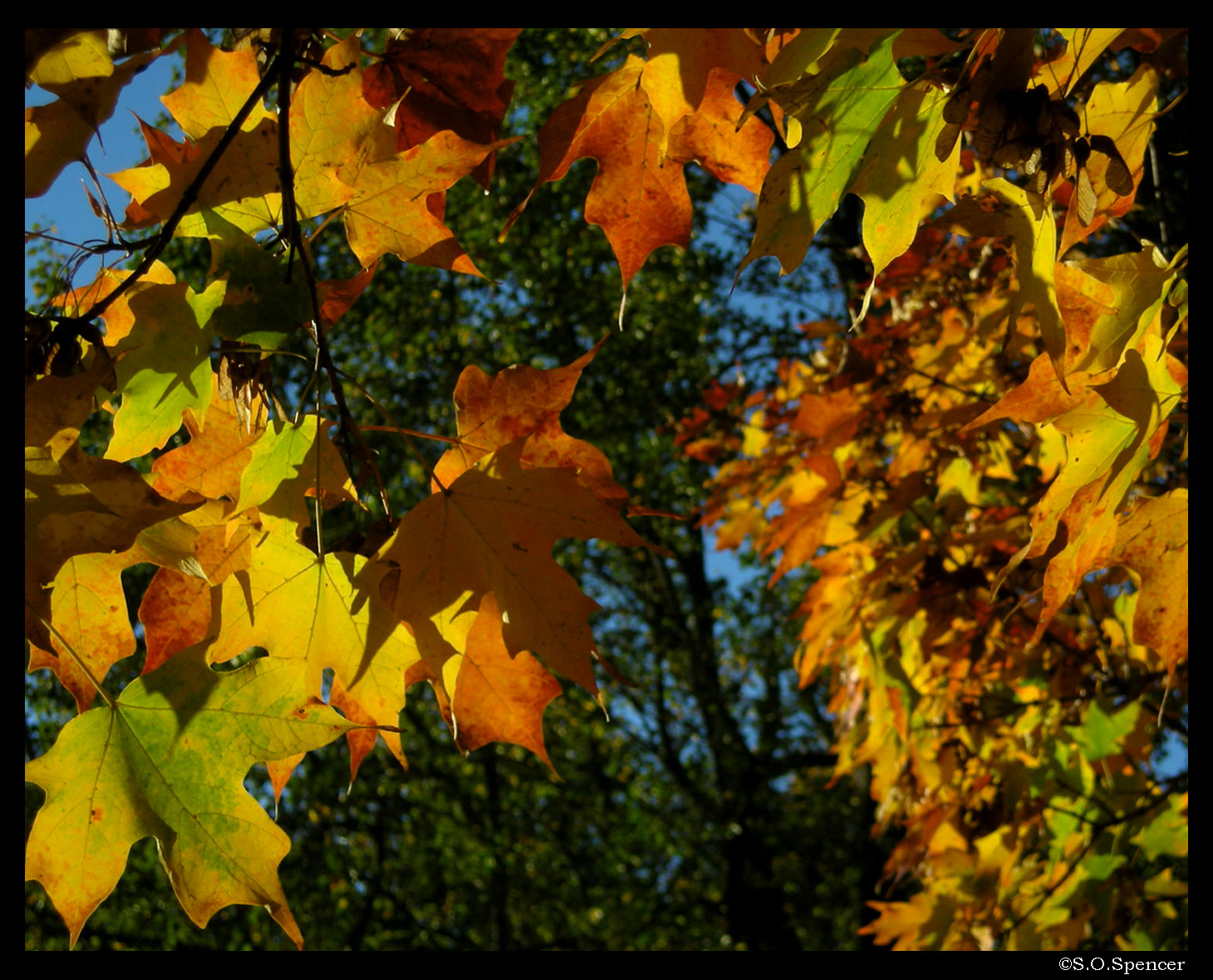
 The Puzzle Box