
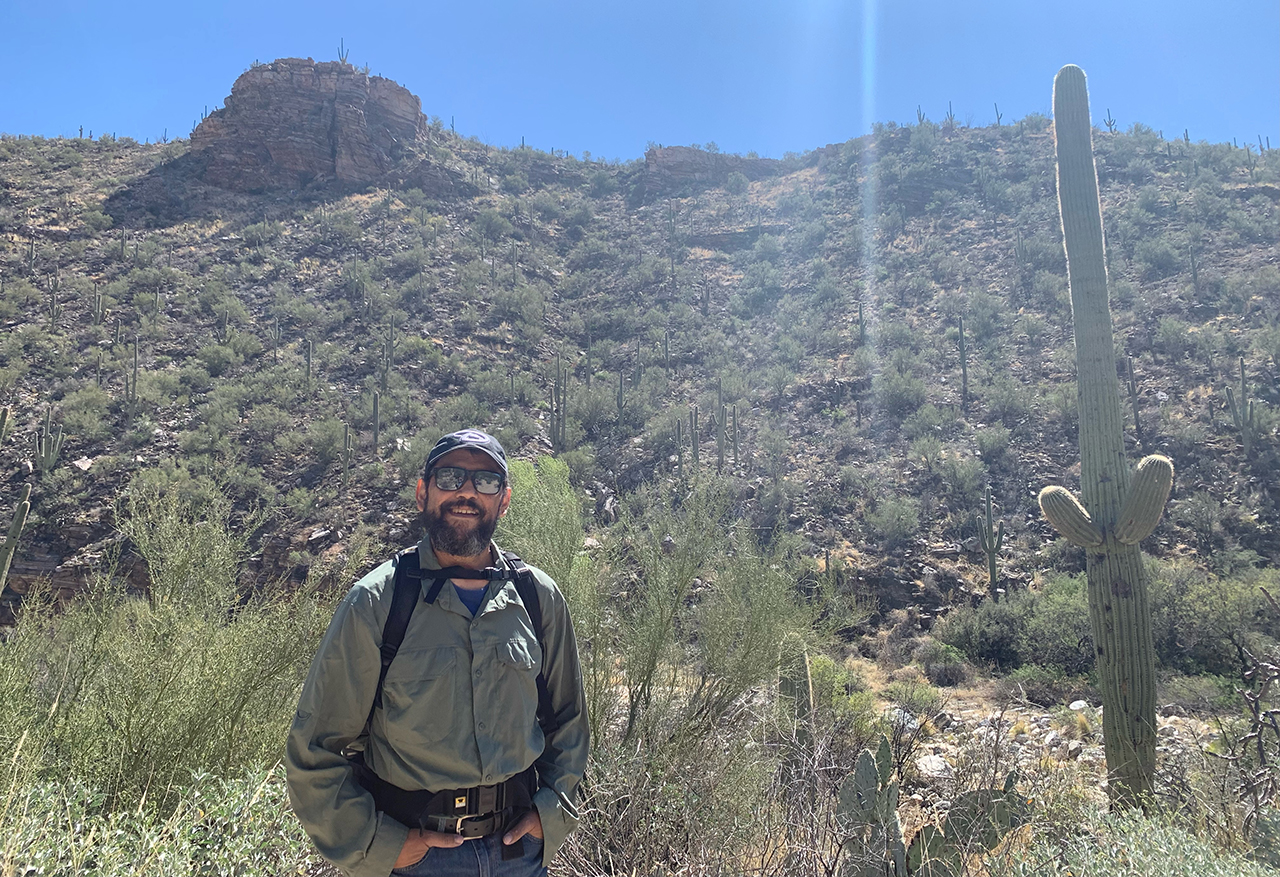
On Monday night, my beloved brother transitioned out of this earthly realm. For many of his friends, this will come as a terrible shock of news and I’m sorry for that. He was diagnosed with metastatic pancreatic cancer just before 2021 Thanksgiving and had been taking treatment for it since. He kept this news close to the vest and told me the Sunday after Thanksgiving so as not to “ruin the holiday” and only because he knew how shocking it would be if something happened to him due to the diagnosis and I learned by getting a call from the hospital. We spent the holidays together, and, with his permission, I let just a few more family members know what was going on. When I visited again in Feb/March, he still hadn’t told anyone new, not even his closest friend Roy, who lived just a few hours north in Phoenix. “I know I need to tell him,” he would say, pensive look on his face. Thankfully, Roy called one day during my visit and Gary broke the news. His support system grew and that’s what he needed/what I wanted for him.
The first round of treatment he took was chemo one week, one week off. After he adjusted to the treatment, he tolerated it better than many. When I visited in December, I was adjusting to seeing him in such a different form—he lost a lot of weight—and he was adjusting to the treatment. I made our Christmas dinner (if you could call it that—I am no cook) with the primary dish being mashed potatoes and corn—his favorite combination from childhood and one I thought could go down easily in a nauseated stomach. Of course, my appetite was normal and often ravenous, so I would say, Hey! Time to eat. What do you feel like? And he would leave it to me, but he would always choose something and would be surprised when his stomach tolerated it. One night I decided on Indian food and he was unsure he could keep it down, but was really craving tandoori chicken. I brought it home and he inhaled it, calling it some of the best he’d had and thanking me for even suggesting it because it wouldn’t have occurred to him if he’d been alone.
I am so grateful he was able to keep moving for most of his time on treatment, too, On New Year’s Day we took a four mile walk around Sabino Canyon Recreation Area. When I returned in March, he was actually a bit better acclimated to his treatment and we took a six mile walk through a place called Seven Falls, taking breaks as needed. We didn’t make it to the end, which he had hoped, but we came damn close. He said he had hoped to make it to the falls so I could take his picture and he could post it and say Fuck Cancer. I told him, “Gary you can do that with any picture we’ve taken on this trail. We’ve been walking for miles and you are going through chemo. I know healthy people who would struggle on this hike.” Together we visited the botanical gardens, the museum of the desert, Pima Air & Space museum, and Colossal Cave. We were both a little nervous with Colossal Cave because we learned we’d be descending six stories below ground and we both knew that meant walking back up. But it was a slow pace and Gary had time to recover during each stop. Gary took me on a tour of the Air Force base and showed me where he worked and explained various elements of the base to me.
When we learned in June that the chemo wasn’t working and a second lesion had grown on his liver and the first had gotten bigger, the doctors switched his treatment to one that targeted the BRCA mutation—a mutation he learned he had after the diagnosis and what likely played the biggest role in him having pancreatic cancer. On June 28, he had a big dinner, eating outside to watch the sunset in a place he and I regularly picnicked whenever we picked up food. He’d gotten into the routine of eating well during his recovery week, particularly the day before, because he knew his appetite would drop off significantly during treatment week. He started his treatment on June 30 and, honestly, never really recovered. His fatigue was debilitating. But he would also tell me, “I’m working through it.” He started responding to my texts more infrequently during this time. Texting was hard due to neuropathy. Finally, in the week when he was to start his next chemo session, he called and said he was going to the ER at the VA. His neighbor, who was also a friend, had been helping him and was alarmed at how weak he was. In the ER he learned that the liver lesions had grown even larger and the chemo likely triggered an infection that was just throwing the body into chaos. He soon learned there wasn’t much more they could do for treatment with a liver so deeply compromised (his body was already showing the impacts of a failing liver at this point).
I arrived early Friday morning and after processing the news together and the corresponding emotions as best we could, we quickly went into our comfortable routine of chatting, reminiscing, laughing laughing laughing. Once he agreed to enter hospice, the nurses unplugged everything and eventually we moved out of the ICU and into a private room elsewhere on the floor. Since it was Friday, everything regarding paperwork would wait until Monday. On Friday and Saturday, he would be as much himself as he could be considering the situation. His friend Roy and Roy’s wife Cam came down at noon on Saturday, bringing him chicken wings from a restaurant Gary loved. They stayed all day, and were still there when I left to go home. On Sunday his neighbor visited, and he had good conversations with his aunt and uncle. I have a great little video snippet of him and his uncle on the phone, telling a story of a mutual friend and laughing laughing laughing. When I arrived Monday, I could sense right away, mostly in the cadence of his speech, that things were already a bit different and that Sunday was likely the last day of near normalcy. Sure enough, as the day progressed, I could see the stages of the transition starting—the most familiar one being his talking to people I couldn’t see or saying something to me out of the blue as if we’d been talking about something unrelated to anything we were experiencing. And this is something I want to share with his friends: that entire part of the process, when the mind was responding to the changes in his body—every word out of his mouth was funny, kind, affirmative. He would repeat over and over, “He’s a good dude.” (If you know Gary, you can probably hear him saying this—it was a common refrain when describing people). At another point he said, “Yeah, it looks like everything is going good for those guys.” Another point he whispered, “Vegas, Vegas, Vegas” (he loved Vegas). “Freaking awesome” and “good freaking deal” also peppered these conversations. When his eyes would come into focus and he’d look at me, I’d say “How you feel?” And he’d always, ALWAYs say, “I’m doing good.” “Are you in any pain,” I’d ask. “No, I’m doing good.” He did get restless in bed, moving around as if he couldn’t get comfortable but every time I’d ask if he needed help, he’d say he was fine and relax for a moment. His agitation never seemed painful or anxious.
By the end of the afternoon his restlessness was increasing and when I asked if he had pain, he said a little. It was then that the nurse gave him a pain med to help with pain and restlessness and once the pain meds hit, he continued the transition with his eyes closed and the process ended at 9:30pm. I held his hand, talked to him, rubbed his legs. I let him know how much he was loved, how grateful we were to have him, and how he would be missed. He and I were with both our parents when they transitioned, and know it can be challenging. I spent much of the weekend just pleading with the universe to let his process be easy—I had read that end stage pancreatic cancer can be quite brutal and I was scared about that. I asked mom, dad, grandma, god, the universal energy to just please let his experience be as peaceful as possible, and I have to say it was. I am so grateful for that.
Gary was retired Air Force. He had turned 50 last year (his birthday is later this month), and had just completed his bachelor’s degree—a lifelong goal—when he received the devastating diagnosis a few months later. We talked about fairness and I shared a quote from Christopher Hitchens regarding Hitchens’ own cancer diagnosis: “To the dumb question, why me? The cosmos barely bothers to return the reply: ‘Why not.’ ” We agreed that this situation fucking sucked beyond measure. Just infuriating. Enraging. But we also acknowledged that this is the way of the human experience. We all face a moment like this. Gary traveled all over the world. He hiked mountains in Korea, rode bikes in Italy, has been to more places than most thanks to his military career. He said he had a great life, and we had had great childhoods supported with family that we loved deeply. There was nothing more he could ask for. Except for more time, of course. There’s never enough time with the people you love on this exquisite planet we inhabit. With his death, my nuclear family—the people who loved me first and longest and without reservation—are all gone. The grief is difficult to put into words
There won’t be a service. He will be interred in a veteran’s cemetery—I’m working on those details. For those he didn’t tell about his prognosis, it was largely because he didn’t want people to feel sorry for him. He wanted people to remember him how we was—your favorite memory of him is what he wanted you to think of when you heard his name. Take a hike in his honor. He loved hiking. And laugh laugh laugh.
 The Puzzle Box