
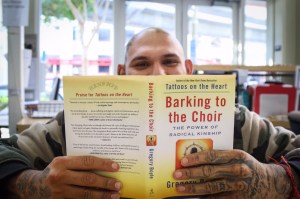
 My last post was about anticipated racism in Vermont. A short time after, I heard a story on NPR about a Nicaraguan man who was living in northern Vermont and considering going back to Nicaragua because of issues relating to his family who was still there. He talked about his time in Vermont and how he loved it here. He said, “I’ve met the very best people here in Vermont.” And I wondered about the people I could be meeting if I were out in the world a bit more, helping the community. I filled out my volunteer application for Meals on Wheels the day before Thanksgiving.
I’ve also been reading this extraordinary book by Father Gregory Boyle called Barking to the Choir: The Power of Radical Kinship. I learned about it through Elizabeth Gilbert’s Instagram page. Father Greg works with gang members in L.A. to help them acclimate to life after prison, or life off the streets, or life after drug addiction. He has a broad and all encompassing view of God and Christianity and religion, which I appreciated. I’m a bit anti-organized religion, identifying primarily as a Buddhist who prefers to find peace and spirituality in the world around me—the woods behind our house or in the quiet of a run—than in some organized way on a particular day of the week. But Father Greg brings in teachings from many religions and poets and writers in ways that resonated with me. He spoke of action as the way of God—forgiveness, compassion, kindness, kinship. It’s a lovely book with tragic and beautiful stories. It made me rethink my own reactions to people in my life. My goal is always to be a friendly face, smiling, smiling. But I’m a grumpy ass in the morning, when I first arrive to work. Various behaviors grate on my nerves. I can get a bit bogged down in the pissiness in my own head, stewing a bit. I try not to let it show, but it can make me feel hard-hearted and tired. Reading this book reminded me of how much our world expands when we strive for an open, non-judgmental heart. One that aims to bring relief, support, love, laughter, kindness to the people around it. One that strives to live the word of God in action: “Meditate on the world, he [Ignatius of Loyola] instructed them, and all that happens in it, packed shoulder to shoulder with God. We live amidst a universe soaked in grace that invites us to savor it.” Also this: “We must try and learn to drop the burden of our own judgments, reconciling that what the mind wants to separate, the heart should bring together. Dropping this enormous inner burden of judgment allows us to make of ourselves what God want the world to ultimately be: people who stand in awe. Judgment, after all, takes up the room you need for loving. Readying oneself for awe, at every turn, insists that compassion is always the answer to the question before us.” Beautiful stuff.
The other thing I realized while reading the book is how afraid I am of messiness. I pride myself on the fact that I have no drama in my life. And when I sense a bit of drama, I drop that situation like a hot potato. I pride myself on the fact that I have a built in drama detector that almost always keeps me from becoming friends with people I later learn are incredible creators of drama. I don’t know this at the time. At the time, I feel like I don’t “click” with the person and so we don’t really become friends. It’s only later, sometimes years later, that I learn of the chaos that follows this person and his/her relationships. It helps to create a peaceful life. But I also wonder if this means I’m not embracing the full spectrum of experiences in the world. Not so much with drama-prone people, but in the sense that I don’t put myself “out there” enough. I’m an enormous animal lover. I don’t eat them. I donate to causes to help them. I have personal standards for how I think dogs should be kept as pets. One fear of becoming a Meals on Wheels volunteer is driving to the homes of people who cannot leave and what if I arrive and there are dogs kept in awful conditions outdoors in the freezing weather. Typing out those words makes me realize how ridiculous it sounds, but it’s a situation that bothers me deeply. So instead I avoid the situation, which neither solves it nor helps the person in need of a food delivery. Putting myself in those situations, regardless of what I might find, is the only way to change anything. And it may not change anything. But neither does avoidance. Father Greg visits prisons, presides over funerals, testifies at death penalty hearings (against it). He’s the first person many of these men and women call when they have trouble or need help. I would find this all quite stressful but he’s bearing witness to their lives and trying to affect change, to help, to show kindness. And I don’t have to be Father Greg. I can help my community in my own, small ways.
The other idea this book highlights is one that has been with me for many years, and has at times really bothered me, and that is the idea that how our lives turn out is largely happenstance/luck. I’m one who hit the lottery of life. Father Greg explains it here:
I am sixty-three years old and I’ve never killed another human being. If I asked you why that is, you might say it is because I know the difference between right and wrong. Or you might suggest that I have sufficient emotional intelligence not to let conflict spiral to such a murderous end. Both are true, but neither is relevant.
There are three great fortunes that have landed in my lap that account for the fact that I have never taken another person’s life:
First: by sheer dumb luck, my life has been almost completely devoid of despair. I have always been able to imagine my future and consequently I care about my life. (And because I do, I care about others’ lives as well.)
Second: I cannot identify any defining trauma in my upbringing or in my life to date that would lead me to such a place of rage. Struggle and suffering, yes. But the golpe of huge, damaging trauma? Never.
Third, I have never been plagued by mental illness. I have never had to navigate schizophrenia or been burdened with sociopathy, psychopathy, or bipolarity. I have issues like everyone else, but I won the mental health lottery. It is not my moral superiority or heightened emotional intelligence that accounts for my lack of murderous past. It is luck. Sheer dumb luck at that.
Every homie I know who has killed somebody —everyone—has carried a load one hundred times heavier that I have had to carry, weighed down by torture, violence, abuse, neglect, abandonment, or mental illness. Most of us have never borne that weight. We are free not to like the truth, but we are not free to deny it.
I have often thought about my good fortune in that I had loving, supportive parents. We were poor/working poor, yet I never feared losing our home, not having food, etc. Many of the stories recounted in this book are of gang members whose mothers abandoned them in apartments, whose fathers broke their arms, whose entire families were drug users and gang bangers. Devastating, tragic stories that explain a lot. And, of course, mental illness can strike anyone at any time. There but for the grace of God goes I. And when you think about what that really means, it can feel a bit frightening.
Mostly, though, Father Greg inspires me to be more patient, more open-hearted, more action-oriented to help when I can.
 The Puzzle Box
Great entry
Thanks, friend